
Learn each essential step of the ISO 27001 implementation journey, from starting the project to achieving certification successfully.
Table Of Content
- ISO 27001 Implementation
- Step 1: Set the project’s goals and scope.
- Step 2: Get the commitment of top management
- Step 3: Set up a team to implement the ISMS
- Step 4: Do a Gap Analysis
- Step 5: Perform a Risk Assessment and Risk Treatment Plan
- Step 6: Develop Mandatory ISMS Documentation
- Step 7: Implement ISO 27001 Annex A Controls
- Step 8: Give training and information about security
- Step 9: Set up a way to measure and keep an eye on performance
- Step 10: Do Internal Audits
- Step 11: Perform Management Review
- Step 12: Get ready for the certification audit.
- Step 13: Get certified and keep getting better all the time.
ISO 27001 is the international standard for information security management. Putting it into action can be hard, but organizations can become compliant and improve their security quickly by following a structured, step-by-step plan. This guide offers a thorough roadmap for implementing ISO 27001, guaranteeing your organization’s readiness for certification.
Key Points
- Take a structured, step-by-step approach
- Get the support of top management and get the resources you need.
- Write down, put into action, and keep an eye on ISO 27001 requirements
- Teach employees about security and make it a part of their work.
- Long-term ISMS effectiveness depends on continuous improvement.
ISO 27001 Implementation
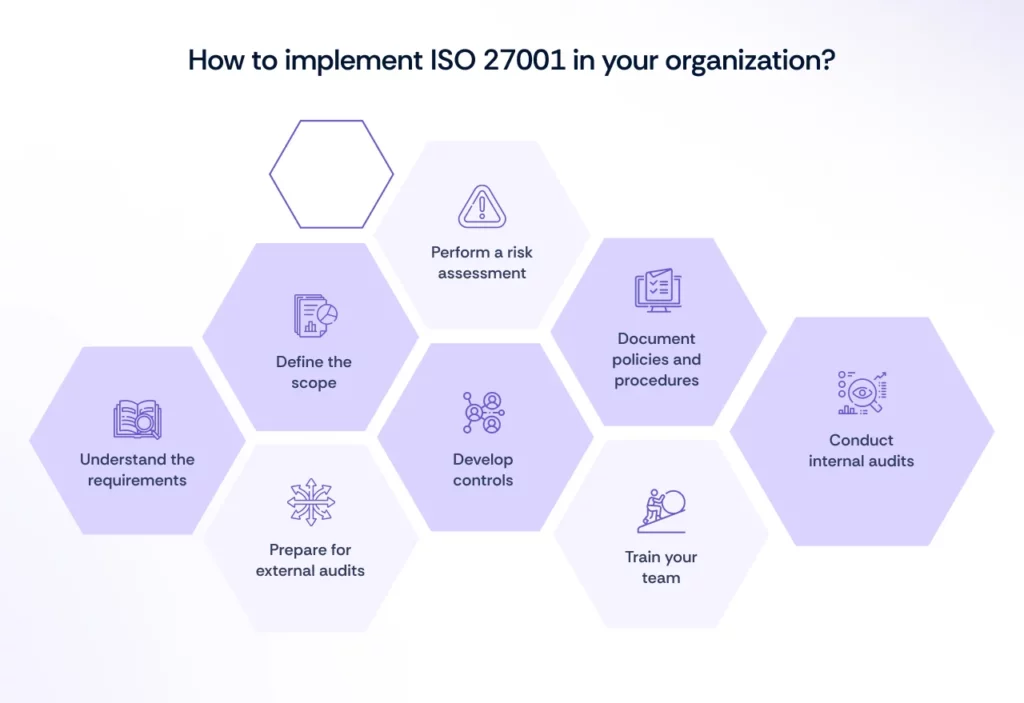
ISO 27001 defines the requirements for establishing, implementing, maintaining, and continually improving an Information Security Management System (ISMS). Adopting a structured implementation process ensures organizations minimize risks, comply with regulations, and foster trust among clients and stakeholders. A phased approach makes things less confusing, holds people more accountable, and lets you see how far you’ve come.
Step 1: Set the project’s goals and scope.
Project Scope: To begin, figure out which parts of your business will be affected by ISO 27001. You need to decide if the ISMS will cover the whole company, just some departments, or just the most important business units.
Objectives: Set specific, measurable goals like lowering risk, following the rules, and raising security awareness. Setting clear goals helps you make sure that your ISO 27001 implementation is in line with your business goals.
Step 2: Get the commitment of top management
For ISO 27001 to work, management must be fully on board. Leaders need to give:
- Time, money, and people are all resources.
- Clearly explaining how important security is
- Help with enforcing policies
The ISMS can’t reach its full potential without the involvement of top management.
Step 3: Set up a team to implement the ISMS
Put together a team with people from different areas of IT, operations, HR, and compliance. Use a RACI matrix to make sure everyone knows what their job is:
- Responsible: The people doing the work
- The project owner is responsible.
- Talked to: Experts in the field
- Informed: Stakeholders
A well-organized team speeds up implementation and makes sure everyone is responsible.
Step 4: Do a Gap Analysis
A gap analysis looks at how your current information security practices stack up against the requirements of ISO 27001. Find places where things aren’t working right and put them in order of risk. This helps you use your resources wisely and deal with the most important weaknesses first.
Step 5: Perform a Risk Assessment and Risk Treatment Plan
Steps for a Risk Assessment:
- Find assets, threats, and weaknesses
- Look at how likely each risk is and how bad it could be.
- Use a risk matrix to rank risks
Risk Treatment Plan:
- Choose whether to accept, lessen, move, or stay away from each risk.
- Choose controls from ISO 27001 Annex A
- Write down why you chose the measures
Step 6: Develop Mandatory ISMS Documentation
ISO 27001 needs certain paperwork, such as:
- Policy on Information Security
- Methodology for Risk Assessment and Treatment
- Statement of Applicability
- Policies for managing incidents, controlling access, and keeping an eye on things
Best practice: keep documents short, easy to find, and up to date.
Step 7: Implement ISO 27001 Annex A Controls
Annex A lists 114 controls in 14 different areas. These controls may need to be put in place:
- Technical steps (like firewalls and encryption)
- Organizational steps (like separating duties and setting up approval workflows)
- Physical measures (making sure server rooms are safe)
Use a project plan to keep track of how things are going.
Step 8: Give training and information about security
People are often the weakest part of keeping information safe. Teach employees how to:
- Policies and procedures for security
- How to spot phishing attempts
- Telling people about security problems
A strong training program makes sure that the ISMS is used correctly by everyone in the company.
Step 9: Set up a way to measure and keep an eye on performance
Use Key Performance Indicators (KPIs) and Key Risk Indicators (KRIs) to keep an eye on how well ISMS works:
- Number of security problems
- Following the rules
- Progress of actions to fix things
Continuous monitoring lets you make changes before problems happen, which makes risk management better.
Step 10: Do Internal Audits
Internal audits check that the ISMS meets the standards set by ISO 27001. Some of the steps are:
- Setting up the audit’s scope and schedule
- Looking over written procedures and proof
- Telling people what you found and taking steps to fix it
The organization gets ready for the certification audit by doing internal audits.
Step 11: Perform Management Review
Management reviews look at how well ISMS is doing and how well it fits with the company’s goals. Add:
- Results of the risk assessment
- Results of the audit
- Ways to make things better
- Changes in the rules or requirements for organizations
Management review makes sure that support is always there and that things get better all the time.
Step 12: Get ready for the certification audit.
There are two parts to certification:
- Stage 1: The certification body reviews the documentation.
- Stage 2: The ISO 27001 implementation is assessed on-site.
To get ready,
- make sure all documentation is up-to-date,
- fix any problems that have been found,
- and involve staff who will be working with auditors.
Step 13: Get certified and keep getting better all the time.
When you get certified:
- Do regular surveillance audits
- Keep making the ISMS better based on what you’ve learned.
- Change policies, controls, and risk assessments
ISO 27001 certification is not the end; it needs to be kept up and improved all the time.